
Kent County Parole and Probation Compared
A person may leave a jail or prison under several legal arrangements, and the label matters. The Texas Board of Pardons and Paroles decides parole and discretionary mandatory-supervision cases. The TDCJ Parole Division supervises people after those state-prison releases. A Kent trial court, by contrast, imposes community supervision as part of a judgment. The Kent clerk preserves the judgment and later orders, but the clerk does not act as the supervising agency.
| Record type | How it begins | Best verification source |
|---|---|---|
| Parole | Conditional release from TDCJ after a Board decision | TDCJ IVSS, Parole Status Line, or TDCJ records |
| Mandatory supervision | Statutory state-prison release under applicable eligibility rules | TDCJ IVSS and Parole Division |
| Community supervision | Sentence or deferred disposition ordered by the trial court | Kent judgment, conditions, and later court orders |
| Bond release | Pretrial release after bond and holds clear | Host-jail booking-out sheet and Kent bond order |
How to Verify Kent County Post-Release Supervision
Begin with the custody path, because Kent County does not have a broad public parolee directory or a local online probation lookup. Ask whether the person left Dickens County Jail or Garza County Jail, transferred to TDCJ, or received a Kent court sentence that imposed community supervision. Then follow the source that owns that status.
- For a prison case, search TDCJ IVSS using the correct TDCJ identity. It covers people in TDCJ custody or on parole or mandatory supervision.
- Call the TDCJ Parole Status Line at 844-512-0461 for person-specific review status. After a favorable vote, Review and Release Processing at 512-406-5202 can confirm whether release processing was completed.
- For supervision location questions, contact TDCJ at io@tdcj.texas.gov. For an existing record, use pia@tdcj.texas.gov and provide a full name plus TDCJ number, SID number, or birth date.
- For probation, request the judgment, conditions, modifications, revocation orders, and any discharge or judicial-clemency order from the Kent clerk.
- Pair the supervision record with the host jail's booking-out sheet when the exact physical departure from Dickens or Garza matters.
Note: Absence from the current TDCJ inmate locator does not prove parole, discharge, or community release.
Kent County Supervision Contact Routes
No Kent-specific parole office or public local probation directory was found in the reviewed official sources. That gap makes the state and court routes more important. Do not select an office based only on the person's home county, because TDCJ can assign supervision elsewhere and a trial court can identify the proper community-supervision department in its order.
Person-specific verification
Texas Board of Pardons and Paroles / TDCJ Parole Division
Parole Status Line: 844-512-0461
Review and Release Processing: 512-406-5202
Supervision questions: io@tdcj.texas.gov
Records: pia@tdcj.texas.gov
Kent County Clerk and 39th Judicial District Clerk
P.O. Box 9 / 101 Main Street, Jayton, TX 79528
806-237-3881
The clerk can identify the judgment and court orders in a Kent case. Ask the clerk which department administers a community-supervision order if that fact is not clear in the file.
Kent County Conditions, Violations, and Warrants
Conditions are person-specific. Parole or mandatory-supervision conditions may include reporting, approved residence, travel limits, treatment, or other Board requirements. Community-supervision conditions appear in the Kent court file and can change through later modification orders. A violation allegation can lead to a warrant, hearing, revocation, or renewed custody, but an allegation is not the same as a final finding.
No general Kent County absconder list was found. The Texas DPS Public Sex Offender Registry may mark a person with a registration duty as absconded, but it is not a directory of all people on parole or probation. Most supervised people do not belong in that registry. Verify a suspected warrant or revocation through the supervising agency and the court instead of treating a missing portal result as proof.
Reading Texas Parole Decisions for Kent Cases
TDCJ identifies an initial parole case about six months before eligibility and later reviews about four months before the review date. An institutional parole officer prepares a case summary, then a three-member panel reviews the file. Two votes determine the result. This is an administrative file review, not a public calendar of parole-grant hearings.
FI-1 means release when eligible; FI-2 names a future month and year; treatment variants require program steps; RMS refers to release to mandatory supervision. NR sets a later review after denial, SA means serve all subject to mandatory-supervision law, and DMS denies mandatory supervision and sets a later review. Even an approval can be withdrawn if new information arrives.
The Board's parole review page explains this sequence. The official page shown below is a guide to process, not proof that a named Kent County person was released.
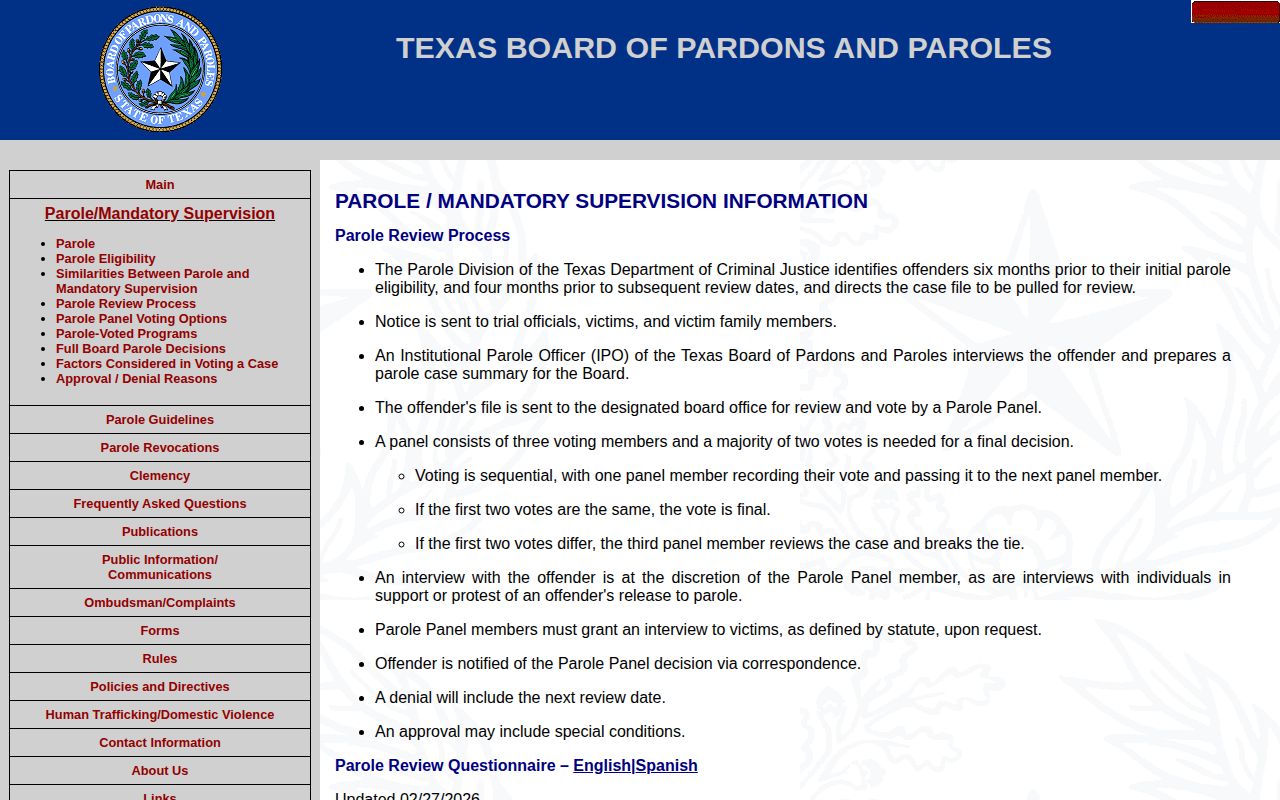
Use the vote code only as a status point. Ask Review and Release Processing whether the person physically left TDCJ, then ask Parole Division whether supervision began.
How Kent County Supervision Ends
Supervision ends through the authority that created it. For parole or mandatory supervision, obtain TDCJ confirmation of discharge rather than relying on an inmate-search no-result. The current TDCJ locator includes only people incarcerated in a TDCJ facility, so silence can have several causes. TDCJ IVSS and a Public Information Act request are better historical routes.
For community supervision, request the signed discharge or judicial-clemency order from the Kent clerk. A docket entry helps establish chronology, but the operative signed order is stronger. If the person was first held outside Kent, the Dickens or Garza booking-out record still establishes when that jail episode ended. The site's Kent County release-record guide explains how those jail and court records fit together.
Texas Government Code Chapter 552 governs requests for government records, subject to exceptions. A narrow request for existing documents, with the person's booked name, cause number, and date range, is more useful than asking an agency to calculate or explain a legal outcome.
Kent County Jail Release Is Not Parole
Kent County does not appear to operate an active jail. Kent Sheriff may transport a person to Dickens, Garza, or another host that must be confirmed. Leaving that host on bond, dismissal, time served, or a county sentence does not create TDCJ parole. Likewise, a jail entry that says transferred to TDCJ is a custody transfer, not release into the community.
Ask the Kent County Sheriff's Office which host received the booking. Ask the host for the booking-out time and disposition. If the record names TDCJ, move to the state channels. If the Kent judgment orders community supervision, use the court and assigned supervision office. Keeping these channels separate prevents a common false match.
A person can also leave a host jail after a dismissal or after serving a county term. Neither result implies ongoing supervision. Conversely, a person whose parole was revoked may return to custody after an earlier lawful release. Use dates and signed records to distinguish the episodes rather than collapsing them into one status.
Kent County Supervision Notifications
Texas has two notification systems with different populations. IVSS-Counties covers participating county jail and court interfaces. It may report a booking, release, transfer, or court event. TDCJ IVSS covers a state prisoner and can continue into parole or mandatory supervision, with notices for Board decisions, parole eligibility, prison release, and discharge.
Search the exact identity before subscribing. Select the contact methods desired and complete the verification shown by the live portal. Former VINE users may need to reset a password after Texas changed county vendors in 2025, while migrated preferences may remain. Do not follow old instructions that promise a four-digit PIN unless the current screen asks for one.
A notice is a navigation aid. It can arrive after staff complete operational steps, and a transfer notice does not mean community release. Call the named custodian when destination, door time, or supervision start matters.
Kent County Supervision Record Checklist
A narrow record request helps separate decision, release, and supervision. For TDCJ, request the parole review result, release type, completed release date, assigned supervision information subject to disclosure, and eventual discharge record. For the Kent court, request the judgment, conditions, modification orders, revocation orders, and final discharge or judicial-clemency order.
Use the full legal name, birth date, TDCJ or SID number, and Kent cause number when known. Ask for electronic copies and a cost estimate before work passes a chosen amount. Government bodies provide existing documents; they are not required to prepare a legal analysis or decide what a record means for the requester.
Keep the source scope in the final wording. A Board approval is an approval pathway. A host-jail release sheet proves departure from that jail. A Parole Division record confirms state supervision. A Kent signed order confirms the court action. Together, those sources can establish a clear chronology without overstating any single entry.
When records conflict, ask each custodian to confirm its own entry and preserve the response date. Do not choose the most convenient label.